

Charging several e-cars at the same time poses new challenges, and not only for power grid operators. Find out here how you can save investment and operating costs with intelligent load management systems
1. Why load management?
The expansion of the charging infrastructure is on everyone's lips. The federal government is also promoting the expansion of commercial charging infrastructure. For this reason, many companies are planning to install charging stations with several charging points for their company location. But what happens if electric vehicles are charged at all charging points at the same time? On the one hand, the building's power grid can be overloaded. In addition, the load cap agreed with the electricity supplier can quickly become a painful cost trap. The electricity consumption for charging the electric cars is added to the electricity consumption of the building. Without load management, load peaks can arise that exceed the grid connection capacity agreed with the electricity provider. As a result, carefully negotiated electricity supply contracts become obsolete, the entire annual electricity volume is billed at a higher electricity price per kWh and there is a risk of high additional operating costs.
2. Benefits of Charging Management Systems
With a charging management system, you can distribute the grid connection power available at your location to the existing electricity consumers in a cost-optimized and cost-optimized manner. The advantages are obvious:
- expensive load peaks are avoided,
- no overloading of the building connection,
- flexible installation of additional charging points without investment in expanding the grid connection,
- faster charging of electric cars.
3. What types of load management are there?
Adapted load management solutions are available to meet the requirements for the charging processes of the electric vehicles (vehicle fleet, customer or employee vehicles) as well as the company's existing electricity requirements. For example, an industrial company with seasonal production cycles requires more complex charging management than a pure office building with relatively constant electricity consumption.
Static load management
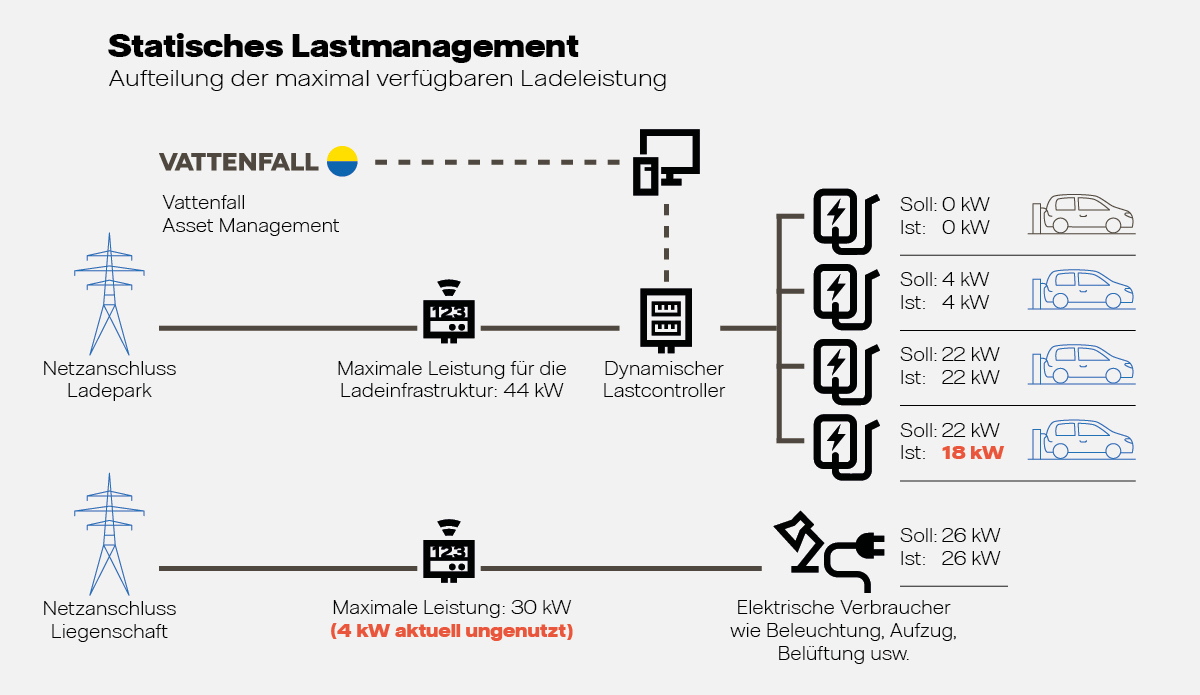
Static load management is always used when a fixed charging capacity can be made available for the e-mobility charging infrastructure within the scope of the power connection capacity. This is either done via a separate grid connection specifically for the charging station or a fixed power is provided for the operation of the charging station via the charging management controller. The power is evenly distributed to the various charging points via the load controller.
Dynamic load management
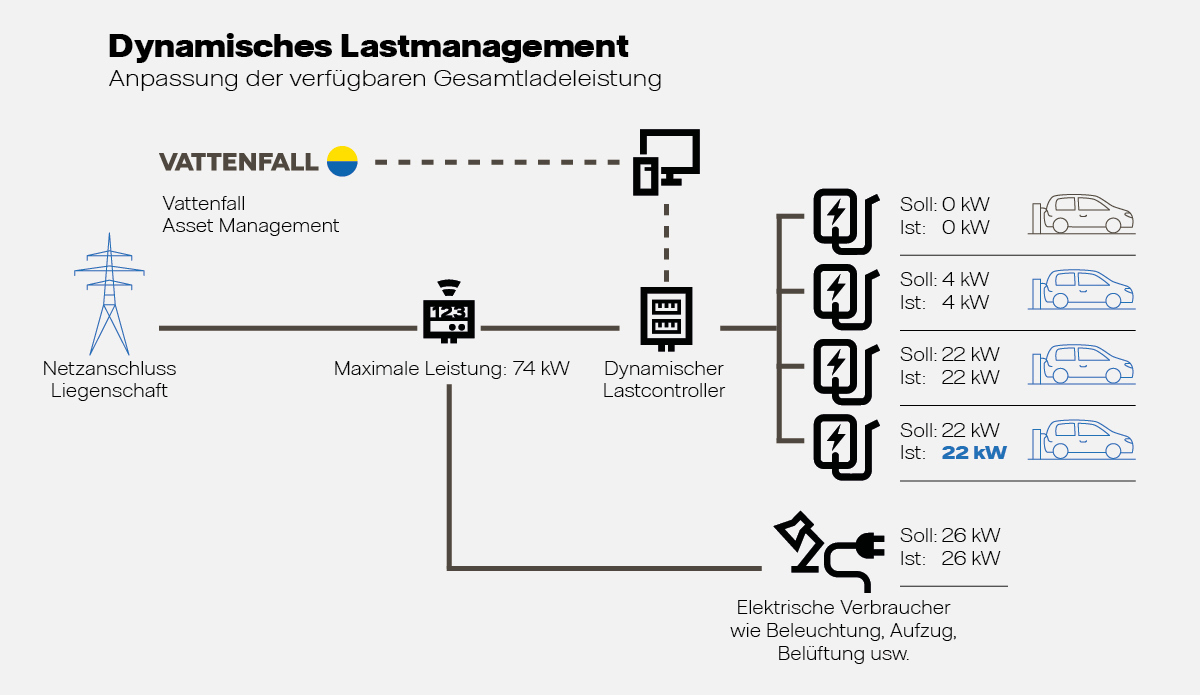
Dynamic load management is the future-proof charging solution for a limited grid connection capacity. Depending on the electricity consumption in the building, for example at different times of the day, the power available for the charging station is flexibly adjusted up to the level of the grid connection load. Additional charging power is available for the charging processes of the e-cars when the power requirement in the building is reduced, which means that the electric cars can be charged more quickly. Based on the vehicle-specific charging power, the available power is divided in each case. If there is less energy available than would be required by all electrical consumers combined, the charging power per vehicle is reduced so that there can be no grid overload or load peaks.
Timetable-based load management
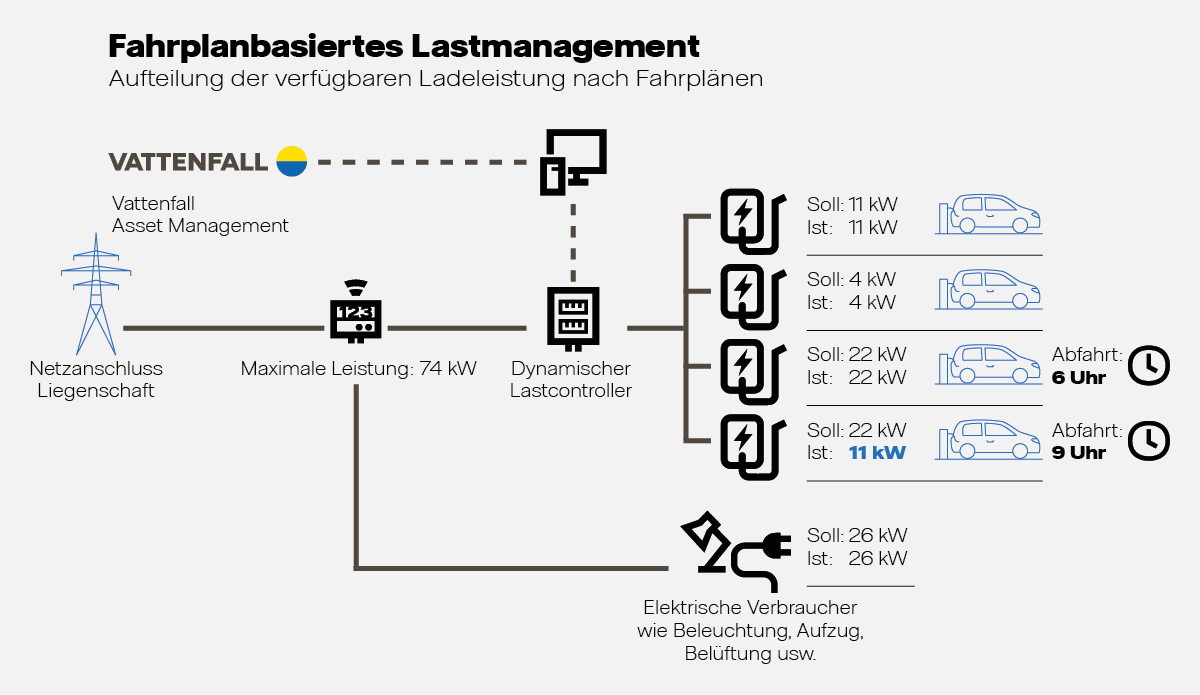
Timetable-based load management is a special form of dynamic load management. Here, the charging power is not only divided on the basis of the vehicle-specific charging power and the energy requirements of the vehicles. In addition, it is taken into account which vehicles must be ready for use again first. This is done on the basis of timetables. These determine, for example, which vehicles should preferably be supplied with higher charging power, or whether vehicles that come to the station later must be supplied with a higher charging power. In this way, the charging of the e-cars can be controlled according to demand.
Holistic energy management
For companies with energy-intensive production processes with large power peaks, it can make sense to control the possible charging power smartly and, if necessary, to include decentralized power supply options in energy planning. Here, our team of experts will be at your side with expert advice on the development of an energy concept for your company.
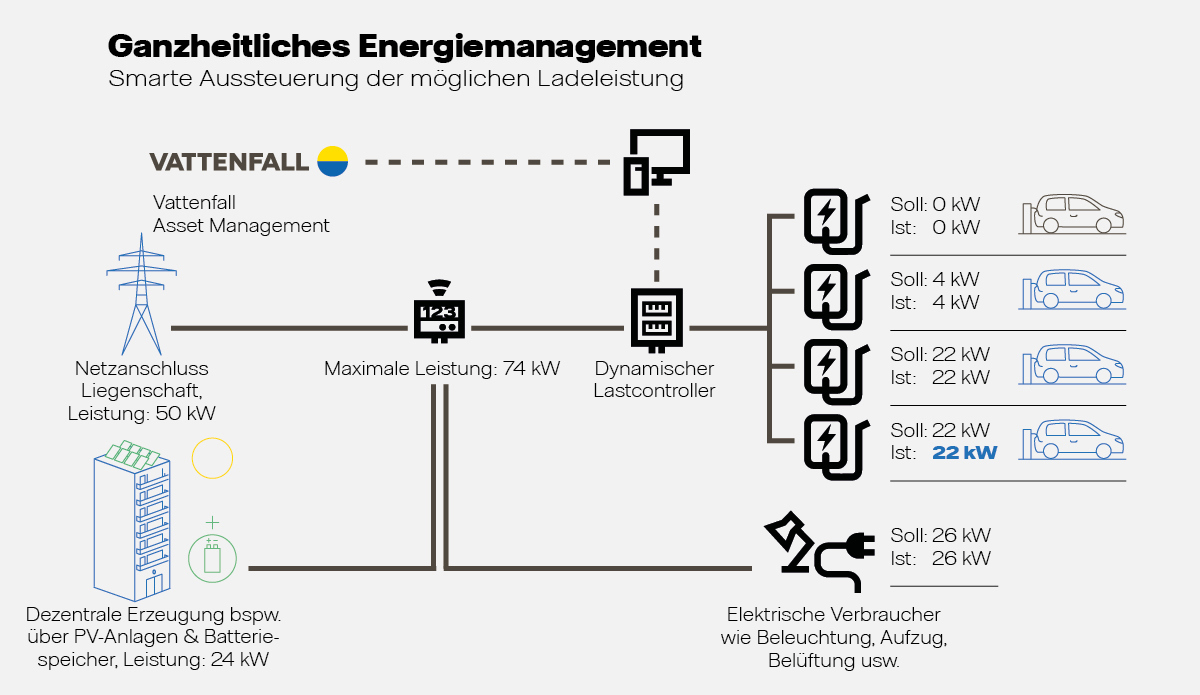
Tip: In the course of installing an intelligent load management system, check the needs of your electrical consumers and the grid capacities agreed with the electricity provider. Active, holistic energy management can lead to significant cost savings. This also includes the possibilities of decentralised power generation (e.g. with PV systems) or peak shaving with suitable battery storage systems.
You can get valuable tips for your electromobility in our monthly e-mobility newsletter. Click here to register.